
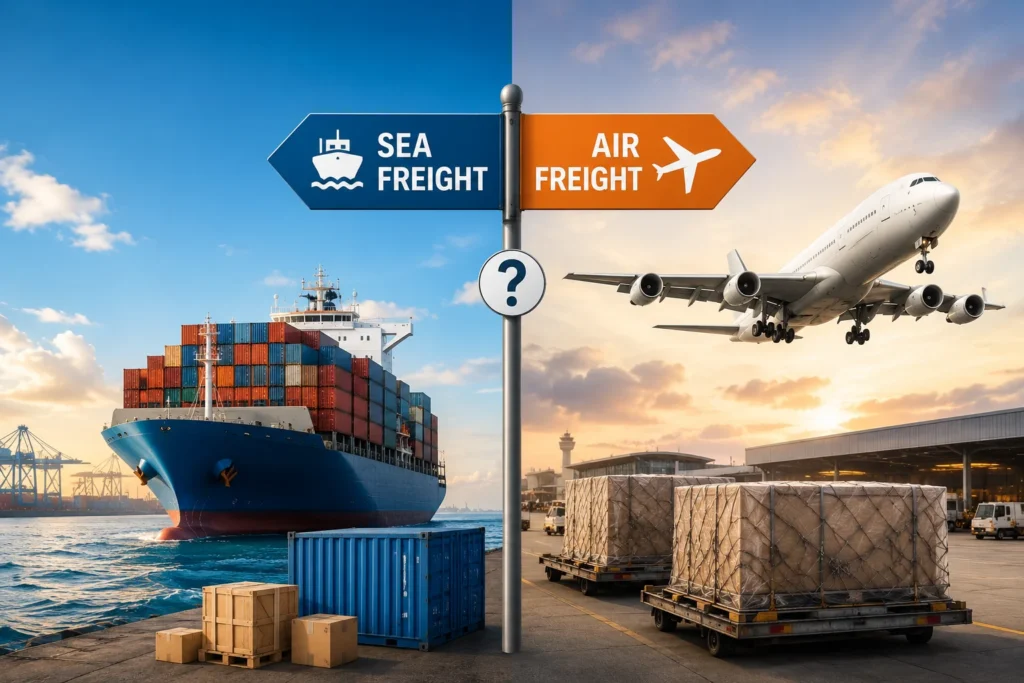
Choosing between sea freight and air freight is one of the most important decisions in international shipping. Both transportation methods offer unique advantages, and the right choice depends on factors such as cost, cargo type, shipment size, and delivery urgency.
Introduction
Choosing between sea freight and air freight is one of the most important decisions in international shipping.
Both transportation methods offer unique advantages. The right choice depends on factors such as shipment size, delivery urgency, transportation costs, and the nature of the cargo.
Understanding the differences between sea freight and air freight can help businesses make better logistics decisions.
Understanding Sea Freight
Sea freight involves transporting goods through cargo ships and international ports.
It is one of the most widely used transportation methods for global trade, particularly for large-volume shipments.
Sea freight options generally include:
- Full Container Load (FCL)
- Less than Container Load (LCL)
- Consolidated shipments
- Port-to-port shipping
- Door-to-door logistics
Advantages of Sea Freight
Cost-Effective for Large Shipments
Sea freight is generally more economical for businesses transporting large quantities of goods.
Suitable for Heavy Cargo
Large, heavy, and oversized shipments can often be transported efficiently through ocean freight.
High Cargo Capacity
Container vessels can transport significant volumes of goods, making sea freight suitable for international trade operations.
Flexible Shipping Options
Businesses can choose between full container loads and consolidated shipments depending on cargo volume.
Limitations of Sea Freight
The primary disadvantage of sea freight is transit time.
Ocean shipments generally take longer compared to air transportation, particularly for long-distance international routes.
Businesses should plan shipments in advance to accommodate longer transit schedules.
Understanding Air Freight
Air freight involves transporting goods through commercial or cargo aircraft.
It is commonly used for urgent shipments and goods that require faster international transportation.
Air freight is particularly suitable for:
- Time-sensitive shipments
- High-value products
- Small and lightweight cargo
- Urgent business requirements
Advantages of Air Freight
Faster Transit Times
Air freight is significantly faster than sea freight, making it suitable for urgent deliveries.
Reliable for Time-Sensitive Cargo
Businesses with strict delivery schedules can benefit from faster transportation.
Global Connectivity
Airports provide extensive international connectivity, allowing goods to move quickly between major global markets.
Suitable for High-Value Goods
Products requiring faster and secure transportation can benefit from air freight services.
Limitations of Air Freight
Air freight generally involves higher transportation costs compared to sea freight.
It may also have restrictions related to:
- Cargo dimensions
- Weight
- Dangerous goods
- Airline regulations
How to Choose the Right Option
When deciding between sea and air freight, businesses should consider:
Shipment Urgency
If goods are required quickly, air freight may be the better option.
Cargo Size and Weight
Large and heavy shipments are generally more suitable for sea freight.
Transportation Budget
Businesses looking to reduce logistics costs may prefer sea freight for non-urgent shipments.
Product Value
High-value and time-sensitive products may justify the higher cost of air transportation.
Conclusion
There is no single shipping method that works for every business.
Sea freight is ideal for cost-effective transportation of large shipments, while air freight is suitable for urgent and time-sensitive cargo.
The right choice depends on balancing speed, cost, cargo requirements, and business priorities.
Flame Star International Company LLC helps businesses evaluate their shipping requirements and coordinate reliable sea freight and air freight solutions across international markets.